
State your case
A primer on the concept of the modern state

What is a state? To most Americans, it’s the political subdivision governing most of your day-to-day lives. It’s the source of local pride and cultural association. California, Texas, New York, all come to mind. So what term comes to mind when I say China, France, or Brazil? “Country” probably is the first word. “Nation” might be the next one.
While both are fine in conversation, I’m going to be pedantic here. The term “country” is broad and all-encompassing and thus analytically pretty useless. The term nation, on the other hand, not only has a very specific (and controversial) definition but is often at odds with its frequent conjunction - the state (ie the nation-state).
So obviously a state is something more than New Jersey. And since I’ve mentioned the concept a few times in passing, first in describing how Donald Trump is on thin ice because the the war on Iran does not address the two main questions posed to the modern state. Then by looking at the social contract that underpins those questions and the legitimacy of the state itself. Both of those were wrapped in current affairs. This week I want to return to Global Adjunct’s core purpose: making the academic concepts of globalization meaningful to your world.
It would be hard to find a more foundational concept to the politics of our modern world than the state. Rather than glide over it and assume everyone knows what I’m talking about, as I’ve done so far, I think it’s worthwhile to understand what it means and how it came to be.
So what is the state? The state is the political entity that is created by the social contract. States exist because of power and are the answer to the question of who has the right to use power. It is the structure that maintains the monopoly of violence.
The next question though is, who or what gives one person or group of people the authority to exercise power over others? That authority is a concept central to the state: sovereignty.
So let’s take a look at how these two concepts: the state and its sovereignty have developed over the last 400 or so years.
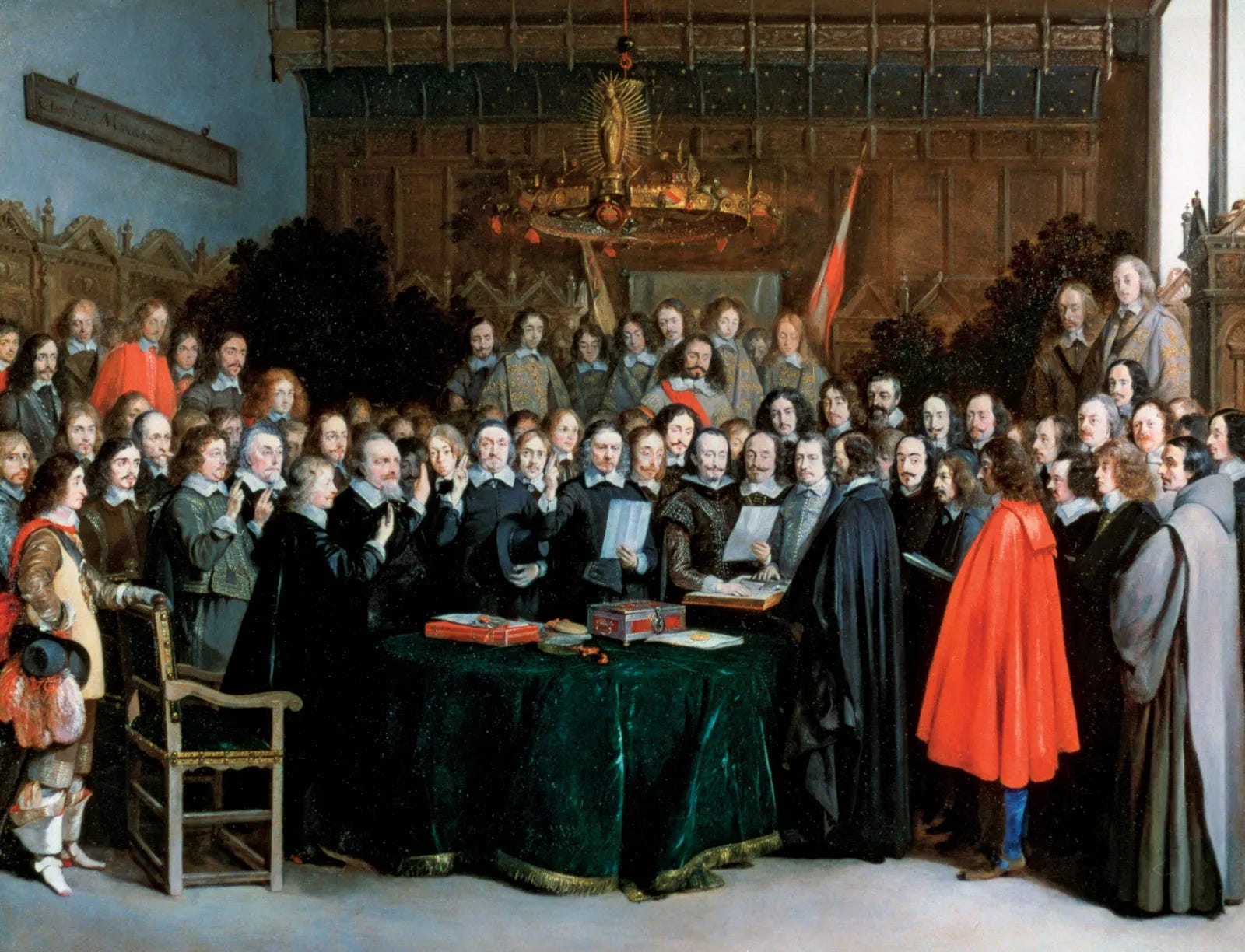
What’s Westphalia?
For the 30 years between 1618 and 1648 Central Europe was a bad place to be. Catholics killed Protestants. Protestants killed Catholics. Armies of mercenaries roamed the countryside, sometimes in the employ of rulers, sometimes simply in between jobs. The Thirty Years War wasn’t so much a war as it was a continent-wide sectarian bloodletting. The specifics of who was fighting whom and over what are only tangentially relevant here.1 What is relevant is the Peace of Westphalia that ended the majority of the fighting, which has traditionally been accepted as the beginning of the international system that we remain in today - the so-called Westphalian system.
In the Westphalian system, sovereigns, that is the emperors, kings, princes, dukes etc., have absolute authority to rule over their empires, kingdoms, duchies, etc. without interference from outside - that is, sovereignty. While states had existed in various forms since the advent of agriculture, from the first literate societies along various alluvial plains to the Greek city-states of antiquity to the feudal monarchies that were being phased out, the Westphalian idea that sovereigns recognized the exclusive sovereignty of others was a novel concept. 2
While there is much academic debate over what the Peace of Westphalia itself actually meant and how much it actually changed, it came during an era of significant political upheaval. As much as any peace treaty or single date can mark a new era, 1648 and the Peace of Westphalia does seem to me to mark a real shift in how, at least in Europe, sovereigns interacted with each other. Perhaps most importantly it ended the idea of a Europe united under one Christianity. This decades-long divorce of church and state, which had begun when Martin Luther posted his 95 theses in 1517, was not yet complete but the Peace was a significant step of secularization.3
L’etat, c’est nous.
While Louis XIV never uttered the apocryphal, “L’etat, c’est moi,” the idea that the state is synonymous with the king himself is consistent with the commonly accepted idea that sovereignty lay with the sovereign. In other words, the authority to rule belonged to the ruler himself and was bestowed on him by god. The so-called divine right of kings is a justification for rule that goes back just about as far as the idea of the state itself.4
That justification began to be challenged, at least in Europe, around the same time as the Thirty Years War. First, in 1588, the Dutch Republic was founded in rebellion against Spanish overlords. Then, in 1642, the English Parliament rebelled against King Charles I’s attempts to impose himself as an absolute monarch. Both of these served as examples of authority derived from some sort of agreement between sovereign authority and the governed beyond a god-given right. It’s no coincidence that Thomas Hobbes, of Leviathan fame, developed his social contract around this time.
As social contract theory developed, through Hobbes, Locke, and Rousseau, politics on the ground evolved alongside. The American Revolution became a successful example of an expanded popular sovereignty where the authority is vested in the consent of the people (i.e. “When in the course of human events it becomes necessary for one people…” or “We the People…”). Next, the French Revolution and subsequent Napoleonic Wars spread the concept of the nation and its citizens as a political force.5
While, as I noted above, the nation and the state are colloquially synonymous today, that was not always the case and there are important differences between the two.6 Nations are the cultural, linguistic, ethnic and social groups with a common history. Sometimes the borders of nations mirror those of states but often they don’t. For instance, historical states like the Ottoman or Austro-Hungarian Empires played host to literally dozens of nations. The reverse can also exist. Somalis, for example, are scattered across 5 different states (hence the 5-pointed star on the Somali flag).
While the French Revolution can be seen as the conception of the nation and the idea of citizens “owning” the state, the Revolutions of 1848 also known as the “Springtime of the Nations” should be seen as its birth. Over an extraordinary 18-month period, peoples across Europe rose up in an expression of nationalism and expanded popular sovereignty. This popular sovereignty, in the eyes of the revolutionaries, would be expressed through constitutions that provided political rights for members of the nation. While the success of these revolutions varied, as a continent-wide movement, they heralded the creation of the modern nation-state - that is, the combining of the ethno-culturo-linguistic identity with the power of sovereignty.7
Montevideo
The end of World War I saw the popularization of the idea of “self-determination,” that is, that nations should be able to express their political will and become sovereign. Rather than the “League of States”, we get the League of Nations, which was an attempt to support the concept of self-determination. It was in this spirit that the Montevideo Convention was held in 1933.
The Convention outlined the 4 attributes that define a state they are:
A permanent population
A defined territory
Government
Capacity to enter into relations with other states.
This is still the accepted definition of a state in international law.
The convention also declares that “the political existence of the state is independent of recognition by the other states.” This “declarative theory of statehood” means that other states don’t have to recognize a state for it to exist, and is in contrast to the “Constitutive theory” which had been widely accepted wherein a state had to be recognized by others. Nearly 300 years after its initial conception, Montevideo codified the self-determination of the Westphalian state.
Challenges to Westphalia
Depending on who you ask over the last decade, the modern nation-state is either in a state of decline or resurgence. In my opinion, while the state remains the primary building block of the international system, it is being pressured on all sides.
Political sovereignty is being eroded by supranational organizations like the European Union and, to a lesser extent, the United Nations, which take authority away from national governments. Equally, humanitarian interventions and the right to protect (aka R2P) have provided grounds for those supranational groups and “coalitions of the willing” to intervene in the affairs of (weaker) states.
Globalization undermines the economic sovereignty of states and the ability of governments to make policies in the best interest of its citizens by pitting their welfare against economic growth.8 This was first seen in the Structural Adjustment Programs of the 1980s that forced governments to cut social spending and open their economies in return for financial bailouts. Since then, economic growth has been the lodestar for the vast majority of economic policy.
These external pressures, particularly the latter economic realities, have created an internal pressure. I quote here at length from the Guardian article I linked to above:
For increasing numbers of people, our nations and the system of which they are a part now appear unable to offer a plausible, viable future. This is particularly the case as they watch financial elites – and their wealth – increasingly escaping national allegiances altogether. Today’s failure of national political authority, after all, derives in large part from the loss of control over money flows. At the most obvious level, money is being transferred out of national space altogether, into a booming “offshore” zone. These fleeing trillions undermine national communities in real and symbolic ways. They are a cause of national decay, but they are also a result: for nation states have lost their moral aura, which is one of the reasons tax evasion has become an accepted fundament of 21st-century commerce.
So, what is a state?
Let’s return to that initial question. The modern state and the system in which it operates was conceived in the Treaty of Westphalia. Popular national sovereignty was born through a series of revolutions - those of the US, France, and 1848. And finally came of legal age through the Montevideo Convention of 1933. It is now in a bit of a midlife crisis. Whether it survives as it is currently constituted or evolves into something new is, for me, one of the most interesting questions that faces our world.9
If you want to learn more about The Thirty Years War, I recommend C.V. Wedgwood’s eponymous book.
I can feel historians cringing at this. There’s a lot of discussion about whether the feudal system actually existed at all, let alone whether the reality post-Westphalia was actually that different but this post is painting with a rather large brush so stick with me. And that doesn’t even touch my whitewashing of several millennia of human history. Oh well.
Again, probably nails on a chalkboard to historians but we push on.
Indeed many of the first state rulers were priests themselves and derived their power from their ability to either communicate with, or their closeness to, the divine. Or their own semi-divinity.
I told you I was painting with a broad brush.
Don’t get me started on the completely empty term “country”
The modern nation-states of Germany and Italy both owe their unification to the aftermath of 1848. I’m currently reading Revolutionary Spring on this so you can expect more on the subject soon.
This is the argument of Mark Robinson, whose Epochal Crisis I’ve written about previously and intend to cover again soon.
For an interesting future history in which states are replaced by corporations, have a listen to Season 11 of Mike Duncan’s Revolutions podcast.